Best Time to Fertilize a Lawn:
The Complete Seasonal Guide
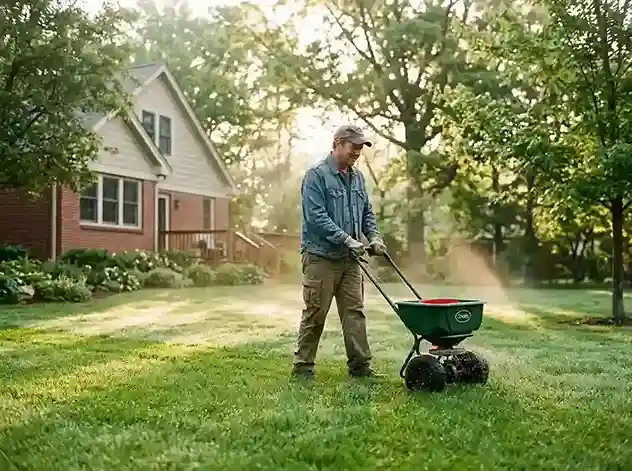
The best time to fertilize a lawn is during its active growing season. For cool-season grasses (like those in Kenosha and the Midwest), that means late August through October (fall, the most critical window) and late April through June (spring). For warm-season grasses like Bermuda, fertilize from late spring through summer. Apply in early morning or late afternoon for best absorption and to prevent fertilizer burn.
Why the Timing of Fertilization Matters So Much
If there’s one truth that every Lawn Care Kenosha professional will tell you, it’s this: applying the right fertilizer at the wrong time is nearly as harmful as not fertilizing at all. Timing determines whether your lawn can absorb and use those nutrients — or whether they burn the grass, leach into waterways, or simply go to waste.
Grass, like all plants, has distinct growth cycles. When it’s actively growing, its root system is hungry and efficient — pulling nitrogen, phosphorus, and potassium deep into the soil for dense, green growth. When it’s dormant, stressed by heat, or waterlogged, applying fertilizer is counterproductive. The nutrients sit on the surface, potentially scorching blades or washing off in a storm.
According to turfgrass science, the golden rule is simple: fertilize when the grass is growing more roots than blades. This typically happens in late summer and early fall for cool-season lawns and during summer for warm-season turf. Understanding this principle is the foundation for every fertilization decision you’ll make.
✅ Signs It’s the Right Time
- Grass is actively growing (mowing weekly)
- Soil temperature is above 55°F
- No heavy rain forecast for 48 hours
- Moderate temperatures (50–80°F)
- Grass is in its peak seasonal growth period
🚫 Signs to Wait
- Grass is dormant or brown
- Heat wave forecast (above 90°F)
- Soil is frozen or waterlogged
- Heavy rain (3+ days) is expected
- Lawn is newly stressed or recovering
What Time of Day Is Best to Fertilize a Lawn?
Most homeowners ask about the season, but the time of day is equally important — especially in Kenosha’s warm summers. Apply fertilizer at the wrong hour and you risk burning the very lawn you’re trying to nourish.
🌅 Early Morning (6 AM – 10 AM) — The Gold Standard
Early morning is widely considered the best time of day to fertilize a lawn. Here’s why: temperatures are cool, morning dew on the grass blades helps granular fertilizers begin dissolving and working into the soil, and the grass has the rest of the day to absorb nutrients before evening dew sets in. There’s no risk of the midday sun superheating fertilizer salts and scorching your turf.
🌆 Late Afternoon (4 PM – 7 PM) — An Excellent Second Choice
If early morning doesn’t work for your schedule, late afternoon is your next best option. By this time, peak heat has passed, reducing the burn risk. The fertilizer has overnight to absorb before morning sun intensity returns. Avoid applying after 7 PM in humid conditions, as extended moisture on blades can encourage fungal disease.
☀️ Midday — Avoid If Possible
Fertilizing between 10 AM and 4 PM — when temperatures and UV intensity are highest — creates the greatest risk of fertilizer burn. The heat causes moisture to evaporate rapidly from the soil, concentrating fertilizer salts around grass roots and blades. In summer, this can turn green turf brown within 24 hours.
Always water your lawn lightly after applying granular fertilizer — unless rain is forecast within 24 hours. This activates the fertilizer and washes any granules off the blades to prevent burning. Our residential lawn care team times every application to the weather forecast and soil conditions for maximum results.
Seasonal Fertilizing Guide: A Year-Round Calendar
Understanding when is the best time to fertilize a lawn starts with knowing how each season affects your grass. Here’s a complete breakdown:
Wait until soil hits 55°F. Late April–May for cool-season grass. Avoid applying too early — shallow roots result.
Prime time for warm-season grass (Bermuda). Cool-season lawns should get minimal feeding to avoid stress.
The MOST important window for cool-season lawns. Late Aug–Oct feeds roots for spring green-up. Don’t skip this one.
Never fertilize frozen or dormant grass. In Kenosha, fertilizing ends by mid-October for most lawns.
| Season | Cool-Season Grass | Warm-Season Grass | Nitrogen Rate |
|---|---|---|---|
| Early Spring | Wait — apply only after soil reaches 55°F | Do NOT fertilize — still dormant | — |
| Late Spring (May–June) | Light feeding if needed (½ lb N / 1,000 sq ft) | First application after green-up | ½–¾ lb N |
| Summer (July–Aug) | Minimal or none — risk of burn | Primary feeding season (every 4–6 weeks) | 1 lb N |
| Early Fall (Aug–Sept) | Most critical feeding of the year | Final light application (early Sept) | ¾–1 lb N |
| Late Fall (Oct–Nov) | Winterizer application (slow-release N) | Stop — risk of frost damage | 1 lb N (cool-season only) |
| Winter | Do not fertilize — grass is dormant | ||
Best Time to Put Spring Fertilizer on a Lawn
Spring is the most tempting — and most misused — window for lawn fertilization. As soon as the snow melts and the first green blades appear, many homeowners reach for the fertilizer bag. This is often a mistake.
The best time to put spring fertilizer on a lawn is not when the calendar says April — it’s when your soil thermometer reads 55°F at a 4-inch depth. In Kenosha and the broader Midwest, this typically falls between late April and mid-May depending on the year. Apply too soon, and you push vigorous top growth with shallow, underdeveloped roots — making the lawn more vulnerable to summer drought and disease.
Spring Fertilization Best Practices
- Use a slow-release nitrogen formula for spring applications. This feeds roots steadily rather than causing a flush of top growth that demands constant mowing.
- Pair with a pre-emergent herbicide if crabgrass is a concern in your area — timing is critical here too, as pre-emergents need to be applied before soil reaches 55–60°F.
- Soil test first. A $20 soil test from your county extension office tells you exactly what nutrients are deficient — saving you from over-applying phosphorus (which is restricted near waterways in Wisconsin).
- Apply no more than ¾ lb of nitrogen per 1,000 sq ft in a single spring application.
- Water in lightly after application (or plan around incoming rain within 24 hours).
Fertilizing when temperatures are still swinging between freezing nights and warm days — even if the grass looks green — can result in fertilizer burn on tender new growth and encourage shallow rooting. Patience pays off: a lawn fertilized at the right soil temperature in May outperforms one fertilized too early in March every single time.
Cool-Season vs. Warm-Season Grasses: Fertilizing Timelines
The single most important variable in determining the best time of year to fertilize a lawn is your grass type. Cool-season and warm-season grasses have opposite growth rhythms — and fertilizing on the wrong schedule for your grass type can cause serious, lasting damage.
Cool-Season Grasses (Kentucky Bluegrass, Fescue, Perennial Ryegrass)
These grasses dominate lawns across the Midwest, Northeast, and Pacific Northwest — including all of Kenosha, Wisconsin. They have two natural growth peaks: spring (April–June) and fall (late August–October). Summer is a period of semi-dormancy for cool-season turf, and fertilizing during a summer heat wave will cause more harm than good.
If you can only fertilize once per year, fall is the single most important time for cool-season lawns. A robust fall feeding banks nutrients in the root system for a dense, fast spring green-up without the surge of top growth that a spring feeding produces.
Warm-Season Grasses (Bermuda, Zoysia, St. Augustine, Centipede)
These grasses flourish in the heat of summer and go dormant once temperatures drop below 55°F. Their active growth window is late spring through early fall, making summer the primary fertilization season. Fertilizing in early spring before full green-up or in fall as dormancy approaches can trigger tender new growth vulnerable to cold damage.
🌿 Cool-Season Fertilization Schedule
- Late April–May: Light spring feeding (55°F+ soil)
- June: Optional if growth is slow
- July–August: Avoid unless necessary
- Late August–September: Most important feeding
- October–November: Winterizer (slow-release N)
☀️ Warm-Season Fertilization Schedule
- Early spring: Do NOT fertilize — still dormant
- Late April–May: First feeding after full green-up
- June–July: Peak nitrogen applications
- August: Continue regular feeding
- Early September: Final application (low N)
- October+: Stop — approaching dormancy
Best Time to Fertilize a Bermuda Lawn
Bermuda grass is one of the most vigorous, drought-tolerant warm-season grasses available — but getting its fertilization timing wrong can result in a weak, disease-prone lawn. The best time to fertilize a Bermuda lawn is during its active summer growing season, not in early spring as many people assume.
Bermuda Grass Fertilization Timeline
Do not fertilize Bermuda grass while it is still dormant (typically before late April in warmer Southern states, potentially early May in transitional zones). Wait until the lawn has fully greened up — defined as the grass showing consistent new growth across the entire lawn — before making your first application. Fertilizing dormant Bermuda encourages cool-season weeds rather than feeding the grass you want.
Once fully active, Bermuda grass is a heavy nitrogen feeder during summer. Apply 1 pound of nitrogen per 1,000 square feet every 4–6 weeks from late spring through early August. Use a nitrogen-rich product like a 32-0-10 or similar formula that supports vigorous growth and vivid green color.
The final application of the year for Bermuda grass should come in early September — using a fertilizer with low nitrogen but higher phosphorus and potassium (such as a 6-12-12 or 4-12-12 blend). This prepares the root system for winter dormancy without encouraging tender top growth that frost will kill.
Bermuda grass has specific nutrient needs that shift seasonally. A soil test taken in early spring helps you determine whether your lawn needs additional phosphorus for root development or extra potassium for disease resistance heading into summer. Our commercial lawn care team recommends testing every 2–3 years for optimal results.
Note on “Bermuta” Grass
You may have seen searches for best time to fertilize a bermuta lawn — this is simply a common spelling variant of “Bermuda” grass. The fertilization schedule is identical. Bermuda grass (Cynodon dactylon) thrives in warm climates and requires summer-focused feeding as described above.
Best Time to Fertilize a Lawn in the Midwest (Including Kenosha, WI)
The Midwest presents unique lawn care challenges: cold winters, variable spring weather, humid summers, and soils that range from heavy clay to sandy loam. If you’re fertilizing a lawn in Kenosha, Racine, Milwaukee, or anywhere in Wisconsin, your schedule revolves around cool-season grass management — most likely Kentucky bluegrass, fine fescue, or perennial ryegrass.
Kenosha Lawn Fertilization Calendar
| Month | Action | Notes |
|---|---|---|
| January–March | No fertilization | Ground typically frozen; grass dormant |
| April | Soil test; wait for 55°F soil temp | Pre-emergent application if crabgrass is a concern |
| Late April–May | First spring feeding | Use slow-release fertilizer; ¾ lb N / 1,000 sq ft |
| June | Optional light feeding | Only if lawn looks thin or pale; avoid in heat |
| July–August | Skip or minimal | Heat stress period; risk of burn is highest |
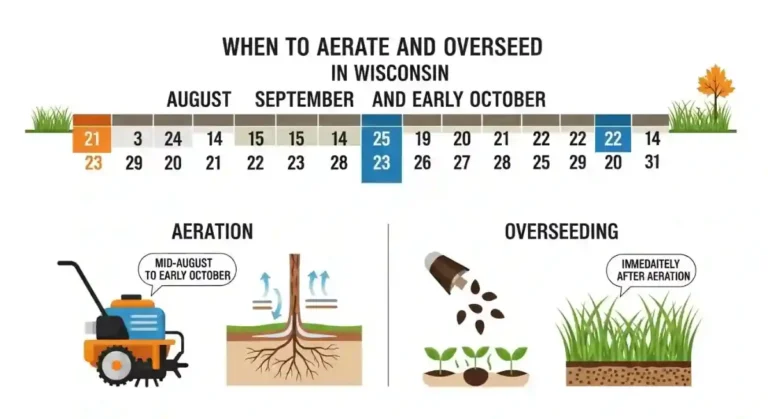
| Late August–September | Most critical feeding | ¾–1 lb N; great time to overseed and aerate too |
| October–early November | Winterizer application | 1 lb N slow-release; banks nutrients for spring |
| Mid-November+ | Stop fertilizing | Ground approaching freezing; no absorption |
This schedule is the foundation of what our team at Lawn Care Kenosha uses for maintaining lush, dense turf across Kenosha County. Our Kenosha Landscaping Services team integrates fertilization with overseeding, aeration, and weed control for a comprehensive seasonal program.
Wisconsin law restricts the application of phosphorus-containing fertilizers on established lawns unless a soil test demonstrates deficiency. Most Kenosha lawns have adequate phosphorus — choose a phosphorus-free formula (middle number = 0, e.g., 28-0-6) for routine maintenance applications. Violating this regulation can result in fines and contributes to algae blooms in Lake Michigan tributaries.
Best Time to Fertilize a New Lawn
A newly established lawn — whether seeded, sodded, or sprigged — has different nutritional needs than a mature lawn. The rules shift significantly, and applying standard lawn fertilizer too early or in the wrong formulation can harm tender seedlings before they’re established.
For New Seeded Lawns
Apply a starter fertilizer at or immediately before seeding. Starter fertilizers are high in phosphorus (the middle number), such as 18-24-12, which supports root development and seedling establishment. Phosphorus is the critical nutrient at this stage — it drives root growth and helps seedlings anchor quickly in the soil.
Once the new grass has been mowed two to three times (indicating it’s established and growing vigorously), transition to your regular seasonal fertilization schedule as described throughout this guide.
For New Sod
New sod comes with its own soil and existing root system. Apply a starter fertilizer within the first two weeks of installation, then water generously to help roots integrate with the native soil. Avoid walking on new sod until it’s firmly rooted — typically 2–4 weeks. After the first 6–8 weeks, treat the lawn with the standard seasonal schedule appropriate for your grass type.
Timing Considerations for New Lawns
The best time to establish a new cool-season lawn in the Midwest is late summer to early fall (mid-August through September). This gives seeds the ideal germination temperatures and a full fall growth window to establish before winter. Spring establishment is possible but requires more intensive irrigation management through summer heat. A new lawn started in fall will be significantly more vigorous by the following spring than one started in spring under the same care conditions.
When NOT to Fertilize Your Lawn
Knowing when to hold off is just as valuable as knowing when to apply. Here are the key situations where fertilizing will hurt more than help:
- During a drought or heat wave: Heat above 90°F combined with fertilizer salt draws moisture away from grass roots, causing rapid browning. If your lawn is brown from heat stress, water first — not fertilize.
- Before or during extended heavy rain: Three or more consecutive days of rain will wash fertilizer into storm drains and waterways before the lawn can absorb it. This is both expensive (you’re wasting product) and environmentally harmful.
- On frozen ground: Fertilizer cannot be absorbed by dormant roots, and runoff from frozen ground can be extremely damaging to water quality in nearby lakes and streams — a major concern for Kenosha’s proximity to Lake Michigan.
- On freshly stressed lawns: If your lawn has just recovered from pest damage, disease, or severe drought, give it 2–3 weeks to stabilize before feeding. Stressed roots can’t absorb nutrients efficiently.
- Too frequently: Over-fertilizing — especially with quick-release nitrogen — builds thatch, creates shallow roots, and increases disease susceptibility. Most lawns need only 2–4 applications per year following a planned schedule.
Proper timing, appropriate products, and correct application rates are the foundation of effective lawn care and maintenance. If you’re uncertain, our residential lawn care services team is always available to conduct a lawn assessment and build a customized plan for your property.
Choosing the Right Fertilizer for the Right Time
Timing is half the equation — choosing the right fertilizer formulation is the other half. Here’s a quick guide to matching fertilizer type to the season:
Slow-Release (Controlled-Release) Fertilizers
Slow-release formulations are ideal for spring and fall applications when you want steady, sustained feeding over 8–12 weeks. They reduce the risk of nitrogen burn, require fewer applications, and are gentler on the environment. Look for products with polymer-coated urea (PCU) or methylene urea as the nitrogen source.
Quick-Release Fertilizers
Quick-release products deliver immediate green-up — useful for correcting a deficiency fast or when you need visible results quickly. They should always be applied with caution, at lower rates, and during cool parts of the day. Never apply more than 1 lb of quick-release nitrogen per 1,000 sq ft in a single application.
Organic Fertilizers
Organic options (compost, feather meal, bone meal, milorganite) release nutrients slowly through microbial activity, making them largely season-safe and environmentally friendly. They’re an excellent choice near water features, in neighborhoods with storm drain restrictions, or for homeowners who want to build long-term soil health. The Trusted Hardscapers and Hardscaping projects we design often incorporate landscape beds that benefit from the same organic soil-building principles as organic lawn fertilization.
Winterizer Fertilizers
Applied in late fall (October–early November in Kenosha), winterizer fertilizers are specifically formulated with higher potassium levels to improve cold hardiness and disease resistance through the winter months. The nitrogen they contain is almost exclusively slow-release, feeding roots through the late fall without encouraging blade growth that would be killed by frost.
How Fertilization Fits Into a Complete Lawn Care Program
Fertilization never works in isolation. The most effective lawn care programs combine properly timed fertilization with complementary practices that maximize how well your grass can absorb and use those nutrients.
Aeration is the single most powerful companion to fall fertilization. Core aeration removes plugs of compacted soil, opening channels for fertilizer, water, and oxygen to reach the root zone. When combined with overseeding and a fall fertilizer application, aeration creates the ideal environment for a thick, weed-resistant lawn.
Mowing height affects how efficiently a lawn uses fertilizer. Keeping cool-season grass at 3–4 inches shades the soil, reduces moisture evaporation, and allows deeper root development — all of which improve fertilizer uptake.
Irrigation management before and after fertilization is critical. Dry soil absorbs granular fertilizer poorly. Conversely, saturated soil increases runoff. Light irrigation (½ inch) 24 hours before application — followed by another ½ inch immediately after — creates ideal conditions.
Our commercial and residential lawn care programs in Kenosha integrate all of these elements into cohesive, calendar-based treatment plans. Whether you have a small residential lawn or a large commercial property, proper fertilization timing is the backbone of every program we build. Learn more about our commercial lawn care contracts and how we structure multi-season programs for businesses and property managers across Kenosha County.
For homeowners, our residential lawn care services list covers everything from seasonal fertilization and weed control to aeration, overseeding, and Kenosha Landscaping Services that tie your lawn into a beautiful overall outdoor living space.
Frequently Asked Questions
When’s the best time to fertilize a lawn?
For cool-season grasses (the dominant type in Kenosha and the Midwest), the best time is late August through October for the primary fall feeding, and late April through May for a spring application. Fall is the single most impactful window for cool-season turf.
What time of day is best to fertilize a lawn?
Early morning (6–10 AM) is optimal. Cool temperatures, morning dew, and lower UV intensity help fertilizer absorb without burning the grass. Late afternoon (4–7 PM) is a solid second choice. Avoid midday applications during warm months.
What is the best time to put spring fertilizer on a lawn?
Wait until soil temperatures consistently reach 55°F — typically late April to mid-May in Kenosha. Applying earlier pushes top growth with shallow roots. A slow-release fertilizer at ¾ lb N per 1,000 sq ft is the ideal spring application.
What is the best time to fertilize a Bermuda lawn?
Begin fertilizing Bermuda after full green-up in late April or May. Apply nitrogen-rich fertilizer every 4–6 weeks through summer. Make your final application in early September with a low-nitrogen, high-potassium formula. Stop completely as dormancy approaches.
What is the best time to fertilize a lawn in the Midwest?
In Kenosha and across Wisconsin, the two primary windows are late April–May (spring) and late August–October (fall). A late October or early November winterizer application adds a third critical feeding. Avoid summer fertilization during heat stress periods.
What is the best time to fertilize a new lawn?
Apply a starter fertilizer (high phosphorus) at the time of seeding or sodding. Once the lawn has been mowed 2–3 times and is fully established (usually 6–8 weeks), transition to the standard seasonal fertilization schedule for your grass type.
How many times per year should I fertilize my lawn?
Most Kenosha lawns benefit from 3–4 applications per year: a spring feeding, an optional mid-season feeding, a primary fall feeding, and a late-fall winterizer. Over-fertilizing (more than 4–5 times/year) increases thatch buildup and disease susceptibility.
Can I fertilize before rain?
Light rain within 24–48 hours after application is actually beneficial — it activates granular fertilizer and moves nutrients into the soil. However, avoid fertilizing if heavy, sustained rain (4+ consecutive days) is forecast, as this causes runoff before absorption can occur.