Fall Lawn Care Guide for Southeastern Wisconsin | (262) 360-0202
Fall Lawn Care Guide for Southeastern Wisconsin
Your complete fall lawn care schedule — aeration, overseeding, weed control, fertilizing & winterizing
Why Fall Is the Most Important Season for Lawn Care in Wisconsin
If you only invest in one season of professional lawn care in Kenosha, make it fall. While spring often gets all the attention, fall lawn care in Southeastern Wisconsin is the single most impactful thing you can do for a thick, green, weed-resistant lawn the following year.
Here’s why fall works so well for cool-season turf in our region. Grasses like Kentucky Bluegrass and Perennial Ryegrass — the dominant species across Kenosha and Racine County — are in their most active root-growth phase when air temperatures drop to 50–65°F. This is precisely when our Wisconsin September and October days deliver. The soil is still warm from summer, encouraging rapid root development, but the cooler air reduces heat stress. New seed germinates quickly, fertilizer is absorbed efficiently, and broadleaf weeds are highly vulnerable to herbicide treatment.
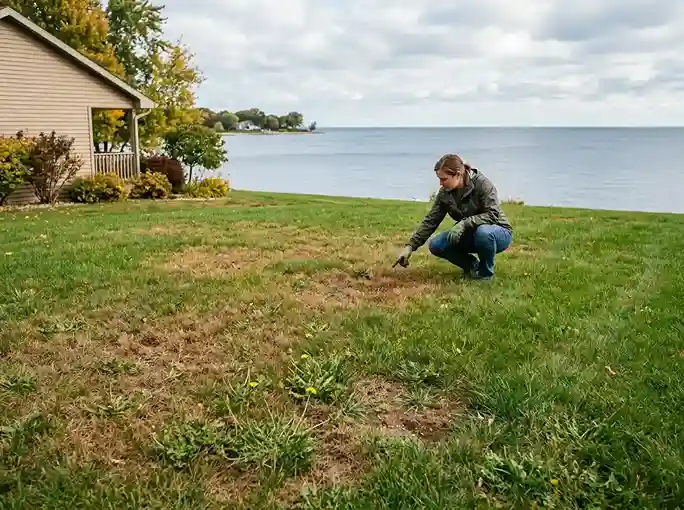
Miss the fall lawn care window — especially aeration and the September fertilizer application — and you’ll spend the following spring trying to recover a lawn that never properly prepared for winter. Lawns that skip fall care are thinner, weaker, and more prone to crabgrass, dandelion takeover, and snow mold disease by the time Kenosha sees its first hard freeze.
Southeastern Wisconsin Climate Note: Kenosha sits in USDA Hardiness Zone 5b–6a. The first frost typically arrives between October 5–20. Your fall lawn care window runs from late August through early November — roughly 10 weeks of critical opportunity. Every week you delay costs you.
Fall Lawn Care Schedule for Southeastern Wisconsin
Timing is everything in fall lawn care. The following month-by-month schedule is calibrated specifically to Kenosha’s climate, frost dates, and cool-season grass growth patterns.
| Task | Ideal Timing (Kenosha) | Why It Matters | Priority |
|---|---|---|---|
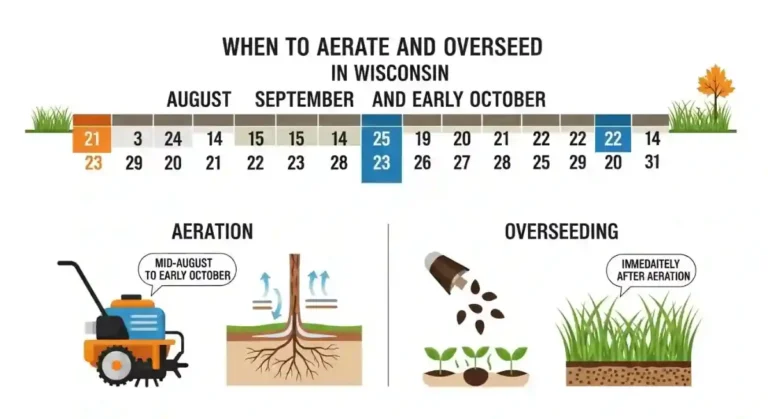
| Core Aeration | Sep 1–15 | Relieves clay soil compaction, opens channels for nutrients | Critical |
| Overseeding | Sep 1–20 | Thickens lawn, fills bare spots before winter | Critical |
| Fall Fertilizer | Sep 10–20 | Feeds root growth, prepares lawn for winter dormancy | Critical |
| Weed Control | Sep 15 – Oct 10 | Kills perennial weeds before they overwinter | High |
| Leaf Management | Oct (ongoing) | Prevents smothering, disease, and turf loss | High |
| Winterizer Fertilizer | Oct 25 – Nov 10 | Stores carbohydrates for winter, enables spring green-up | High |
| Final Mow | Late Oct | Prevents snow mold, reduces vole habitat | Standard |
| Irrigation Winterization | By Oct 15 | Prevents freeze damage to lines and heads | High |
Fall Aeration: The #1 Task for Kenosha Lawns
Core aeration is the cornerstone of any effective fall lawn care guide for Southeastern Wisconsin. Kenosha and Racine County soils tend toward heavy clay composition — dense, compacted soils that suffocate grass roots by limiting the movement of air, water, and nutrients. Annual fall aeration breaks that compaction cycle.
Core aeration uses a hollow-tine aerator to pull cylindrical plugs of soil — typically ½ inch diameter, 2–3 inches deep — from the lawn at 3-inch intervals. These holes create direct pathways for water, fertilizer, and oxygen to reach the root zone. The removed plugs break down on the surface within 2–3 weeks, returning organic matter to the soil.
Fall Aeration Best Practices for Wisconsin
- Timing: Aerate when soil temperatures are between 50–65°F — typically September 1–20 in Kenosha. This aligns with peak root-growth activity in cool-season grasses.
- Soil moisture: Aerate when soil is moist but not waterlogged. Dry, hard soil breaks cores poorly; saturated soil smears rather than pulls clean plugs.
- Mow first: Cut your lawn at its normal height before aerating, then overseed immediately after for maximum seed-to-soil contact.
- Double-pass: For heavily compacted Kenosha lawns, run the aerator in two directions (perpendicular passes) for best results.
- Do NOT aerate with spike aerators: Spike aerators push soil aside, actually increasing compaction. Always use core (hollow-tine) aeration.
Important: Mark your sprinkler heads, invisible fence lines, and shallow utility lines before aerating. Call 811 (Digger’s Hotline) if uncertain about underground utilities.
Our residential and commercial lawn care team at Lawn Care Kenosha performs professional core aeration across Kenosha County each fall. We use commercial-grade equipment that achieves significantly better penetration depth and plug density than rental machines, making a meaningful difference in results.
Overseeding Your Wisconsin Lawn in Fall
Fall overseeding in Southeastern Wisconsin is most effective when combined with aeration. The open aeration holes provide ideal seed-to-soil contact, moisture retention, and protected germination sites that dramatically improve establishment rates compared to broadcast seeding on an unprepared lawn surface.
Best Grass Seed for Kenosha, Wisconsin
Southeastern Wisconsin’s climate — cold winters, warm summers, humid conditions — calls for cool-season grass species. The most successful varieties for Kenosha lawns include:
- Kentucky Bluegrass: The most common and prized grass in Kenosha. Fine texture, deep green color, spreads by rhizomes to self-repair. Requires full sun and regular water. Slow to germinate (14–21 days).
- Perennial Ryegrass: Fast germination (5–7 days), excellent wear tolerance, ideal for high-traffic areas. Often blended with Kentucky Bluegrass to provide quick establishment while Bluegrass fills in.
- Tall Fescue: Deep roots, drought-tolerant, tolerates shade better than Bluegrass. Best for areas with more than 50% shade or sloped areas prone to dry conditions.
- Fine Fescue Blends (Creeping Red, Chewings, Hard Fescue): Excellent for shaded and low-maintenance areas. Low fertilizer and water requirement.
Overseeding Timing and Application Rates
| Grass Type | Seeding Rate (Overseeding) | Germination Time | Best Window (Kenosha) |
|---|---|---|---|
| Kentucky Bluegrass | 2–3 lbs / 1,000 sq ft | 14–21 days | Sep 1–15 |
| Perennial Ryegrass | 5–7 lbs / 1,000 sq ft | 5–7 days | Sep 1–25 |
| Tall Fescue | 6–8 lbs / 1,000 sq ft | 7–12 days | Sep 1–20 |
| Fine Fescue blend | 3–5 lbs / 1,000 sq ft | 7–14 days | Sep 1–20 |
After overseeding, keep the seeded area consistently moist — light watering 2–3 times daily for the first two weeks — until seedlings reach 1.5 inches. Then reduce frequency and increase irrigation depth to encourage deep root development. Avoid heavy foot traffic on newly seeded areas for 4–6 weeks.
Pro Tip: New seedlings are extremely vulnerable to dry conditions. If your fall is unusually dry (which does happen in Kenosha in September), plan to irrigate daily. Even a single day of complete dryness can kill emerging seedlings before they establish a root system.
Fall Fertilizing & Winterizer Guide for Wisconsin Lawns
Fall fertilization is the most effective fertilizer application of the entire year for cool-season grasses in Southeastern Wisconsin. Your lawn’s root system is most active in fall, absorbing and storing nutrients for winter survival and spring green-up. Skipping fall fertilization — or timing it incorrectly — is one of the most common lawn care mistakes Wisconsin homeowners make.
The Two-Application Fall Fertilizer Schedule
For Kenosha and SE Wisconsin lawns, a two-round fall fertilizer schedule is optimal:
Application 1: Early Fall (September 10–20)
Apply a balanced lawn fertilizer with at least 25–50% slow-release nitrogen, as recommended by UW-Madison Extension. The slow-release component ensures a steady nitrogen feed over 6–8 weeks rather than a quick flush that risks burning or promoting excessive tender growth before winter. A ratio of approximately 3-1-2 (N-P-K) works well for most SE Wisconsin lawns at this application.
Application 2: Winterizer (Late October – November 10)
The winterizer fertilizer is the most important single application of the year. Apply it when the lawn has largely stopped growing — typically after the last mow, but while the grass is still green and soil temperature remains above 40°F. The winterizer should be high in potassium (the third number in NPK) with moderate nitrogen. Potassium strengthens cell walls, improves cold hardiness, and helps the grass resist disease through winter. The stored carbohydrates from a well-timed winterizer fuel the first explosive green-up the following April.
Do Not Skip the Winterizer: Lawns that receive a properly timed late-fall winterizer fertilizer emerge from Wisconsin winters significantly earlier in spring, are thicker, and require far less spring recovery fertilization. This is consistently the most high-ROI task in fall lawn care.
Avoid Mid-Fall Nitrogen Overload: Applying high-nitrogen fertilizer in mid-October can cause lawns to go into winter in a soft, succulent condition that is highly susceptible to snow mold disease. Keep mid-fall applications modest in nitrogen and wait for the true winterizer window.
Fall Weed Control & Weed and Feed for Wisconsin Lawns
Fall is not just a good time for weed control in Southeastern Wisconsin — it is the best time of year to attack broadleaf weeds. This is a frequently misunderstood aspect of the fall lawn care guide that separates well-maintained Kenosha lawns from chronically weedy ones.
Here’s why fall weed control is so effective: in September and October, perennial broadleaf weeds like dandelion, clover, creeping Charlie (ground ivy), plantain, and thistle are pulling nutrients and carbohydrates down from their leaves into their root systems to store energy for winter. This downward flow means that post-emergent herbicides applied to the foliage travel directly to the root system — eliminating the entire weed rather than just burning off the visible top growth. Spring herbicide applications are considerably less effective because weeds are pushing growth upward and herbicide movement to roots is limited.
Fall Weed Control: Products and Timing
🌿 Broadleaf Weed Control
Apply a post-emergent broadleaf herbicide containing 2,4-D, MCPP (mecoprop), or Dicamba when temperatures are between 50–80°F. Mid-September to early October is ideal. Do not apply if frost is expected within 24 hours.
🌾 Weed and Feed
Granular weed and feed products combine broadleaf herbicide with fall fertilizer in one pass. Apply when lawn is moist (dew or light watering helps granules stick to weed leaves). Best applied September 15 – October 5 in Kenosha.
🚫 Crabgrass (Annual)
Crabgrass is an annual weed that dies with the first frost — no fall herbicide needed. Fight crabgrass by applying pre-emergent herbicide the following spring (April) and overseeding in fall to thicken the turf and crowd it out.
📋 What to Target This Fall
Primary fall weed targets in SE Wisconsin: dandelion, creeping Charlie, white clover, plantain, wild violet, and ground ivy. These are all broadleaf perennials that respond best to fall treatment.
Fall Weed and Feed Application Tips
- Apply granular weed and feed when the lawn is wet with morning dew or after a light irrigation — moisture helps granules adhere to weed foliage.
- Do not water the lawn for 24–48 hours after applying weed and feed — this allows the herbicide to absorb into weed leaves before being washed off.
- Do not apply weed and feed to newly overseeded areas — herbicides will kill emerging seedlings. Wait until new grass has been mowed at least three times before applying any herbicide.
- Spot-treat isolated weed patches with a liquid broadleaf herbicide rather than applying granular weed and feed to the entire lawn unnecessarily.
- For persistent creeping Charlie infestations, products containing Triclopyr (such as Ortho Chickweed, Clover & Oxalis Killer) are significantly more effective than standard 2,4-D products.
Kenosha Weed Tip: Creeping Charlie (Glechoma hederacea) is one of the most common and stubborn lawn weeds in Kenosha County. It thrives in shaded, moist areas. Fall is by far the most effective treatment window — use a Triclopyr-based product (not standard weed and feed) for reliable control.
Our team at Lawn Care Kenosha’s residential lawn care services includes targeted fall weed control programs using professional-grade herbicides not available to retail consumers. If you’re struggling with persistent broadleaf weed pressure, a professional fall weed control application typically delivers far superior results to DIY products.
Fall Mowing Tips for Southeastern Wisconsin
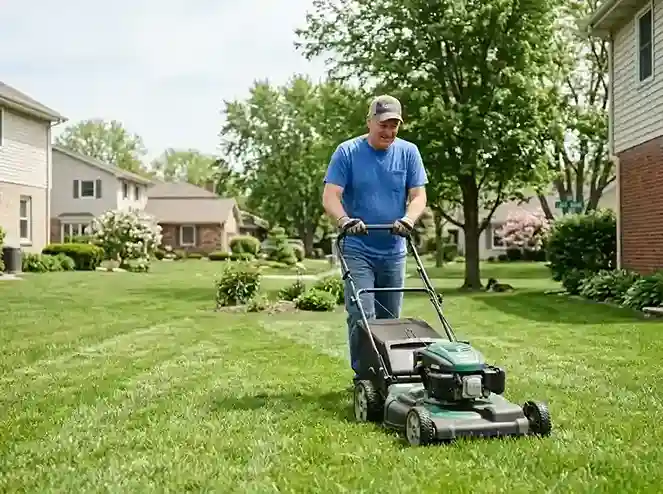
Mowing strategy in fall is different from summer — and getting it right matters significantly for winter health. The University of Wisconsin Extension recommends that mowing until the lawn stops growing is actually the single most important fall lawn care practice for preventing snow mold.
Fall Mowing Height Guidelines
- Summer mowing height (3–4 inches): Continue at normal summer height through August and into early September.
- Transition to 2.5–3 inches: Begin lowering gradually in October — never removing more than one-third of the blade in any single mowing.
- Final mowing height: 2.5 inches. This is the sweet spot for Wisconsin winters — short enough to discourage snow mold and vole habitat, tall enough to protect the crown of the grass plant from freeze damage.
- Stop mowing when grass growth stops — typically late October in Kenosha when soil temperatures drop consistently below 40–45°F.
Do NOT: Cut your lawn below 2.5 inches in fall. Scalping cool-season grasses going into a Wisconsin winter exposes the crown to freeze damage and dramatically increases winterkill risk. Short lawns also warm up more slowly in spring.
Do NOT: Let your lawn go into winter above 4 inches tall. Long grass traps moisture, restricts airflow, and is the number-one cause of snow mold disease in Kenosha lawns. Pink snow mold (Microdochium patch) and gray snow mold (Typhula blight) both thrive under long, matted grass and snow cover.
Leaf Management & Lawn Disease Prevention in Fall
Southeastern Wisconsin’s beautiful fall foliage — oak, maple, ash, and linden are all common in Kenosha neighborhoods — creates a major lawn management challenge. A thick layer of unmanaged leaves is one of the most damaging things you can leave on your lawn going into winter.
Leaves block sunlight, trap moisture, and create the perfect anaerobic environment for fungal disease development. Research from the University of Wisconsin confirms that heavy leaf cover significantly increases the incidence of snow mold, Pythium blight, and other turf diseases common in our region. Beyond disease, leaf mats can physically kill large sections of grass by completely cutting off photosynthesis.
Leaf Management Options
- Mulch-mowing (best for moderate leaf cover): Use a mulching mower blade to chop leaves into fine pieces (roughly dime-sized or smaller). These fragments decompose rapidly, adding organic matter and a small amount of nutrients to the soil. This is ideal for light to moderate leaf fall on turf.
- Rake and bag (required for heavy cover): When leaves are deep enough to mat together and block light — more than a light layer — rake or blow and bag them. Do not leave heavy leaf accumulations on the lawn for more than one week at a time.
- Compost: Collected leaves make excellent compost. Mix with grass clippings and other organic material for a slow-release soil amendment ready by spring.
Regular leaf management is a core part of our residential lawn care and commercial lawn care fall cleanup programs at Lawn Care Kenosha. We also offer commercial lawn care contracts that include scheduled fall cleanup visits so commercial and residential properties in Kenosha County stay clean and healthy throughout the season.
Best Fall Lawn Care Products for Wisconsin in 2026
Choosing the right fall lawn care products makes a significant difference in results. Not all fertilizers, herbicides, and seed blends are created equal — and many products sold at big-box stores are formulated for generic national use, not specifically for Wisconsin’s cool-season turf and climate conditions. Here is a guide to what actually works in Kenosha.
| Product Type | Recommended Picks | Key Ingredient | Best Application Window |
|---|---|---|---|
| Fall Fertilizer (Round 1) | Milorganite 6-4-0, Jonathan Green 24-0-6 Fall Lawn Food, Scotts Turf Builder Fall Lawn Food | Slow-release N (25–50% SRN) | Sep 10–20 |
| Winterizer Fertilizer | Scotts Turf Builder WinterGuard 32-0-10, Pennington UltraGreen Winterizer 22-0-14 | High Potassium (K) | Oct 25 – Nov 10 |
| Weed and Feed | Scotts Turf Builder WinterGuard + Weed Control, Bayer Season-Long Weed Control + Fertilizer | 2,4-D + MCPP + Dicamba | Sep 15 – Oct 5 |
| Broadleaf Herbicide | Ortho Weed B Gon, Spectracide Weed Stop, Triclopyr (for creeping Charlie) | 2,4-D, Triclopyr | Sep 15 – Oct 10 |
| Grass Seed (SE Wisconsin) | Jonathan Green Black Beauty Ultra, Scotts Turf Builder Northern Mix, Pennington Smart Seed Midwest | KBG + PRG blend | Sep 1–20 |
| Starter Fertilizer (for overseeding) | Scotts Turf Builder Starter Fertilizer for New Grass, Jonathan Green Green-Up Seeding Fertilizer | High Phosphorus (P) | At time of seeding |
Product Note: Always select products labeled for cool-season turf and ideally for “Northern” or “Midwest” climates. Avoid products with high quick-release nitrogen in fall, which can promote soft, winterkill-prone growth. When in doubt, ask your local Lawn Care Kenosha professional for a product recommendation specific to your lawn’s soil test results.
Need Professional Fall Lawn Care in Kenosha?
Our team handles aeration, overseeding, fertilization, weed control, and winterization across Kenosha County. Get a free estimate today — fall slots fill fast.
Winterizing Your Lawn & Irrigation System in Wisconsin
Winterization is the final chapter of your fall lawn care guide — and it protects both your turf investment and your irrigation infrastructure from Wisconsin’s harsh winter conditions.
Lawn Winterization Checklist
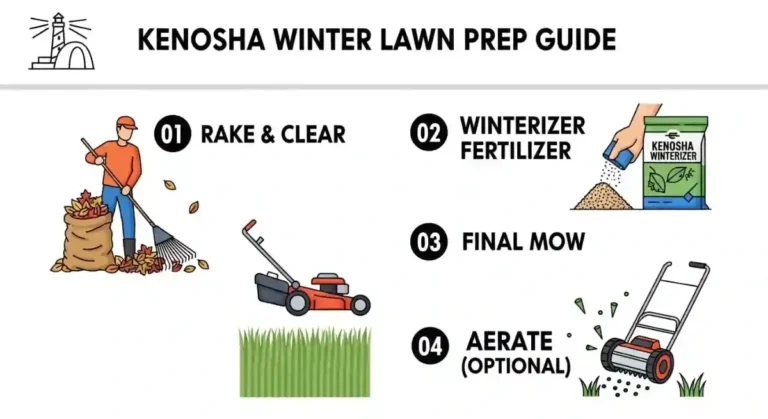
- ✅ Apply winterizer fertilizer before the ground freezes (late October to early November)
- ✅ Complete final mowing at 2.5 inches before growth stops
- ✅ Remove all leaves and debris — do not let them accumulate
- ✅ Mark lawn edges along driveways and sidewalks with driveway markers for snow plow safety (prevents lawn damage from plow blades)
- ✅ Clean and store lawn furniture, garden hoses, and decorative items
- ✅ Repair any lawn edging, retaining walls, or hardscape issues before freeze
Irrigation System Winterization
Failing to winterize your irrigation system in Wisconsin is an expensive mistake. Residual water in lines, valves, and heads freezes and expands, cracking PVC pipes and shattering heads. In Kenosha, you should have your irrigation system blown out — using compressed air to purge all water from every zone — by October 15, at least one week before the first expected hard freeze.
- Shut off the main irrigation water supply valve — typically located in the basement or utility room.
- Run each zone manually to expel residual water from the valve box and above-ground components.
- Blow out each zone with compressed air (40–50 PSI for PVC systems, 25–35 PSI for polyethylene) — this is best done by a professional with a commercial compressor to avoid pipe damage from excessive pressure.
- Insulate above-ground backflow preventers if any components remain exposed after winterization.
- Program the controller to “off” or rain/freeze-sensor override for the winter season.
Our Kenosha landscaping services team offers full-service irrigation winterization in addition to lawn care. We also coordinate with our trusted hardscapers for any fall hardscaping repairs — retaining walls, paver edging, garden borders — that should be addressed before the ground freezes and prevents repair work until spring.
Lawn Equipment Winterization
Before storing your mower and other powered equipment for winter:
- Drain or stabilize fuel in the mower, trimmer, and blower to prevent gumming and carb damage
- Change the engine oil and replace the spark plug for spring readiness
- Sharpen and balance mower blades — a sharp blade cuts cleanly rather than tearing grass
- Clean the mower deck thoroughly to remove compacted grass and debris
- Store in a dry, protected space — temperature swings from wet/dry cycles accelerate metal corrosion
Professional Fall Lawn Care Services in Kenosha, Wisconsin
While many homeowners successfully handle portions of their fall lawn care program themselves, a complete fall treatment — particularly aeration, professional-grade weed control, and properly timed fertilizer applications — delivers substantially better results when performed by experienced local professionals with commercial equipment and Wisconsin-specific knowledge.
At Lawn Care Kenosha, we specialize in comprehensive fall lawn care programs designed specifically for Kenosha County’s soil conditions, microclimate, and cool-season turf. Our fall services include:
- Residential lawn care — complete fall programs including aeration, overseeding, fertilization, and weed control for homeowners across Kenosha, Pleasant Prairie, Somers, and surrounding areas
- Commercial lawn care — property maintenance programs for commercial businesses, HOAs, apartment complexes, and municipal properties
- Commercial lawn care contracts — seasonal service agreements ensuring your property receives timely care throughout the fall schedule without requiring you to track each task individually
- Residential lawn care services list — browse our full list of residential services available individually or as package programs
- Commercial and residential lawn care — single-source lawn management for mixed-use or multi-property clients
- Kenosha landscaping services — fall landscape cleanups, bed preparation, mulching, and seasonal planting
- Hardscaping services from our trusted hardscapers — retaining walls, patio repairs, driveway edging, and decorative stone features best installed or repaired in fall before freeze
Our professionally maintained residential lawn care truck fleet is fully equipped and staffed throughout the fall season. We accept a limited number of new fall clients each season — early booking in August–September is strongly recommended to secure your preferred service schedule before the aeration and overseeding window closes.
Frequently Asked Questions About Fall Lawn Care
Start your fall lawn care in Kenosha in late August to early September, when nighttime temperatures consistently drop below 65°F and soil temperatures are between 55–65°F. The most critical window — aeration, overseeding, and first fertilizer — is September 1–20. Waiting until October means missing the optimal overseeding window and reducing the effectiveness of fall fertilizer applications.
Apply the first fall fertilizer in mid-September (around Labor Day to September 20) using a slow-release nitrogen product. Apply the second (winterizer) application in late October to early November — after the last mow but while the grass is still green and soil temperature is above 40°F. The winterizer should be high in potassium to support winter hardiness and spring green-up.
The best fall weed and feed products for Wisconsin contain a broadleaf herbicide (2,4-D, MCPP, or Dicamba) combined with fall fertilizer. Apply when temperatures are 50–80°F and weeds are actively growing — mid-September to early October is ideal in Kenosha. Apply to a moist lawn and avoid watering for 24–48 hours. Do not apply to newly overseeded areas. For creeping Charlie, use a Triclopyr-based product rather than standard weed and feed for reliable control.
Yes — fall is the best time to aerate in Southeastern Wisconsin. Aerate in early to mid-September when soil temperatures are 50–65°F. Kenosha’s clay-heavy soils particularly benefit from annual core aeration to relieve compaction and improve water, nutrient, and oxygen penetration to the root zone. Always use a core (hollow-tine) aerator, not a spike aerator.
Fall is the most effective time for broadleaf weed control in Wisconsin because perennial weeds are moving carbohydrates down to their roots — which carries herbicides directly to the root system for complete kill. Apply a post-emergent broadleaf herbicide (2,4-D, MCPP, Dicamba) in September to early October. Spot-treat with liquid herbicide for isolated patches or apply granular weed and feed for whole-lawn coverage. Target dandelion, clover, creeping Charlie, plantain, and wild violet.
Lower your mowing height gradually to 2.5 inches by the final mowing of the season — never cutting more than one-third of the blade height at once. Do not cut below 2.5 inches (risks crown damage in cold weather) and do not let the lawn exceed 4 inches going into winter (promotes snow mold disease). Stop mowing when grass growth stops, typically late October in Kenosha.
Yes. Lawn Care Kenosha offers commercial lawn care and commercial lawn care contracts for businesses, HOAs, retail centers, apartment complexes, and institutional properties throughout Kenosha County. Our commercial and residential lawn care programs can be customized to your property’s specific needs and budget. Contact us in August to secure fall scheduling availability.
In Kenosha and Southeastern Wisconsin, winterize your irrigation system by October 15 — at least one week before the first expected hard freeze (which typically occurs October 5–20). Have a professional blow out all irrigation zones with compressed air. Failure to winterize often results in cracked PVC pipes and shattered sprinkler heads, which can cost hundreds to thousands of dollars to repair in spring.
Ready to Schedule Your Fall Lawn Care?
Serving Kenosha, Pleasant Prairie, Somers, Racine, and Southeastern Wisconsin. Professional aeration, overseeding, fertilization, weed control & full fall programs available.