Lawn Fertilization Schedule SE Wisconsin: A Green Guide
Lawn fertilization schedule; it’s the secret behind every lush, vibrant yard that turns heads across Southeastern Wisconsin. But achieving that picture-perfect green isn’t just about regular mowing; it’s about delivering smart, timely nutrition that fits our region’s unique climate. If you’ve ever felt lost choosing the right fertilizer, unsure about when to apply it, or simply want to master your lawn care timing, you’re in the right place.
With over eight years of helping homeowners across Waukesha, Milwaukee, and Racine transform their lawns, I’ve learned that success comes down to precision. Our cool-season grasses, clay-heavy soils, and four distinct seasons, shaped by the influence of Lake Michigan. require a tailored fertilization plan. This comprehensive guide will walk you through everything you need to know: understanding your soil, choosing the right products, and following a month-by-month schedule that keeps your lawn thriving from spring’s first growth to winter’s rest.
Understanding Your Wisconsin Lawn’s Unique Needs
Southeastern Wisconsin presents a distinct set of challenges and opportunities for lawn care. We’re primarily in USDA Hardiness Zone 5b, meaning our lawns are dominated by cool-season grasses like Kentucky Bluegrass, Perennial Ryegrass, and Fine Fescues. These grass varieties flourish in the cooler temperatures of spring and fall and tend to struggle during the heat and humidity of mid-summer.
Our region’s soil types can vary significantly, from the rich loams found in some agricultural pockets to the denser, often poorly draining clay soils prevalent in urban and suburban areas of Milwaukee, Waukesha, and Kenosha counties. The proximity to Lake Michigan can also create microclimates, influencing temperatures, humidity, and even snowfall patterns. These local considerations directly impact how and when your lawn needs nutrients.
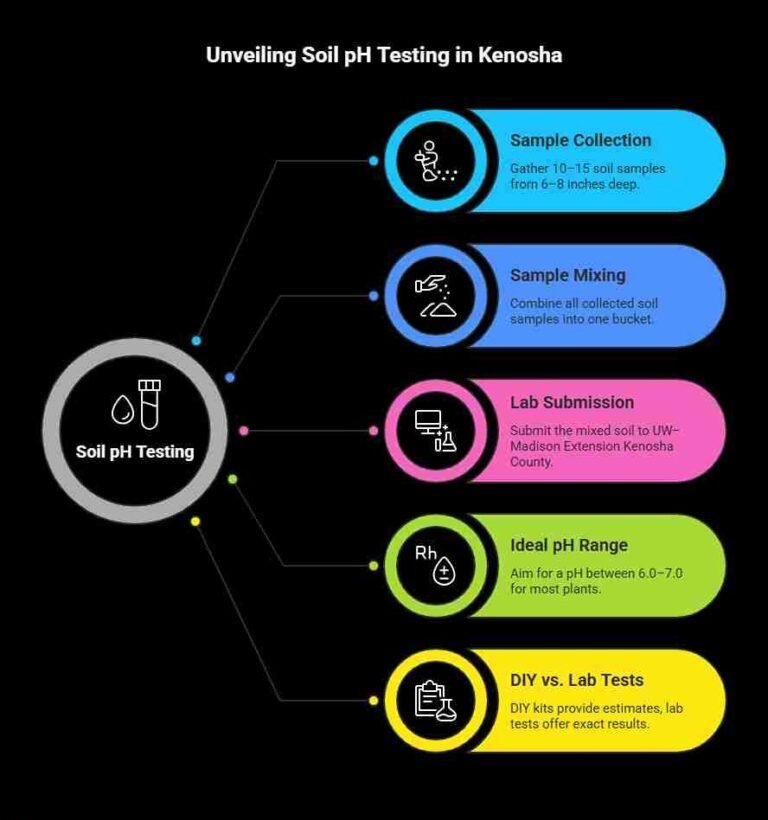
A key factor often overlooked is the soil’s pH and nutrient composition. Without understanding what your soil already has (or lacks), you’re essentially fertilizing blind. This is where soil testing becomes your best friend.
Why Timing Your Fertilization is Crucial for SE Wisconsin Grass Health
Imagine trying to feed a hungry teenager in the middle of the night when they’re asleep – inefficient, right? The same goes for your lawn. Applying fertilizer at the wrong time is not only wasteful but can also be detrimental.
For cool-season grasses in Southeastern Wisconsin, the prime feeding times align with their active growth cycles: primarily spring and fall. Fertilizing during these periods provides the necessary nutrients when the grass is best equipped to absorb them, leading to:
- Stronger Roots: A robust root system is the foundation of a healthy, drought-tolerant lawn.
- Denser Turf: Properly fed grass tillers (sends out new shoots), creating a thicker lawn that naturally chokes out weeds.
- Vibrant Color: Adequate nitrogen application delivers that coveted deep green hue.
- Disease Resistance: A well-nourished lawn is better able to fend off common diseases and pests.
- Efficient Nutrient Uptake: Minimizes runoff and wasted product, protecting our local waterways like the Root River and Lake Michigan.
Applying fertilizer during periods of stress, such as intense summer heat or drought, can actually burn the grass or force it to grow when it should be conserving energy, making it more susceptible to damage. This is why a precise lawn calendar is indispensable.
Your Month-by-Month Lawn Fertilization Calendar for Southeastern Wisconsin
This schedule is designed for established cool-season lawns in SE Wisconsin, assuming 3-4 applications per year. Always adjust based on your soil test results and specific product instructions.
Early Spring (Late March – Mid-April)
- Goal: Wake up the lawn, promote initial green-up, and provide a strong start for the growing season.
- What to Apply: A balanced, slow-release granular fertilizer, ideally with a high nitrogen (N) content (e.g., 20-5-10 or 22-0-10, where the numbers represent N-P-K: Nitrogen-Phosphorus-Potassium).
- Why Slow-Release? It feeds your lawn gradually over several weeks, preventing a sudden growth surge that can deplete energy and reducing the risk of nutrient runoff into our sensitive local ecosystems.
- Key Task: If weeds like crabgrass are a consistent problem, this is the ideal window for applying a pre-emergent herbicide along with your fertilizer. Ensure soil temperatures are consistently above 50°F but before crabgrass seeds germinate.
- Application Rate Example: For a 22-0-10 product, you might apply 4.5 pounds per 1,000 square feet to deliver 1 pound of actual nitrogen. Always check your specific product’s label for precise rates.
- Local Tip: Watch for the forsythia to bloom; it’s a classic sign that soil temperatures are right for spring feeding.
Late Spring (Late May – Early June)
- Goal: Sustain growth, strengthen roots, and prepare the lawn for summer stress.
- What to Apply: Another application of a balanced, slow-release nitrogen-rich fertilizer. Some homeowners opt for a product with a slightly higher potassium (K) content (e.g., 20-0-15) here, as potassium helps with stress tolerance.
- Key Task: Continue with proper mowing practices (maintain a height of 3-4 inches) and ensure adequate watering if rainfall is scarce. This is also a good time to spot-treat broadleaf weeds if they emerge.
- Environmental Note: Be mindful of phosphorus levels. Many parts of Wisconsin, especially near Lake Michigan and its tributaries, have restrictions on phosphorus fertilizer use unless a soil test specifically indicates a deficiency.
Summer (Mid-June – August)
- Goal: Maintain turf health during periods of heat and potential drought. Often, less is more in summer for cool-season grasses.
- What to Apply: Generally, it’s best to avoid heavy fertilization during the peak summer heat (July-August) in SE Wisconsin. Cool-season grasses go into a semi-dormant state to conserve energy. If your lawn looks stressed, consider a very light application of a high-potassium (K) fertilizer or an organic lawn food that won’t “push” growth.
- Alternative: Liquid seaweed or humic acid products can offer stress relief and enhance nutrient uptake without promoting excessive growth.
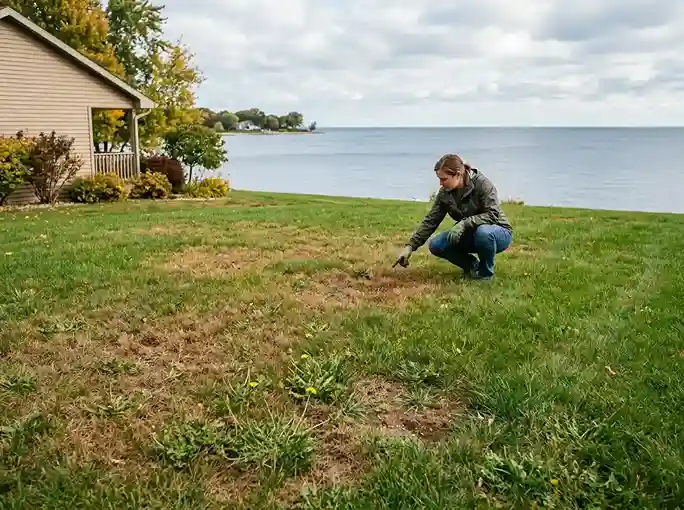
- Local Tip: If your lawn turns brown during a summer drought, it’s likely dormant, not dead. It will typically green up again with cooler temperatures and rainfall. Resist the urge to heavy fertilize brown, dormant grass.
Early Fall (September)
- Goal: Help the lawn recover from summer stress, encourage root growth, and prepare for winter. This is arguably the most important fertilization of the year for cool-season grasses in SE Wisconsin.
- What to Apply: A nitrogen-rich, slow-release granular fertilizer. Many professional Wisconsin lawn care providers opt for products like a 24-0-10. This boosts top growth and, critically, fuels vigorous root development before winter.
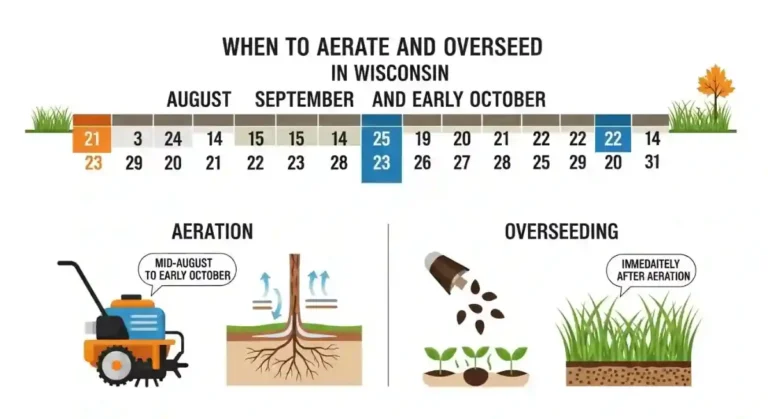
- Key Task: Overseeding (if needed) is best done in early fall, and fertilizer application after seeding helps germination. Continue regular mowing.
Late Fall / Winterizing (Late October – Mid-November)
- Goal: Provide essential nutrients for root development and carbohydrate storage, giving your lawn a head start next spring and boosting its winter hardiness.
- What to Apply: A “winterizer” fertilizer, which is typically high in nitrogen but sometimes includes a bit more potassium (e.g., 18-0-6 or 20-0-10). The key is applying it when the grass has mostly stopped growing but is still green and before the ground freezes solid.
- Why it Works: The grass blades absorb the nitrogen and send it down to the roots for storage. This stored energy will be used for rapid green-up in early spring.
- Application Rate Example: A slightly lower nitrogen application rate than spring, perhaps 0.75 lbs of N per 1,000 sq ft, applied when temperatures are consistently in the 40s and 50s.
- Local Tip: Aim for the application between Halloween and Thanksgiving, depending on the weather. If you wait too long, the ground may freeze, preventing nutrient uptake.
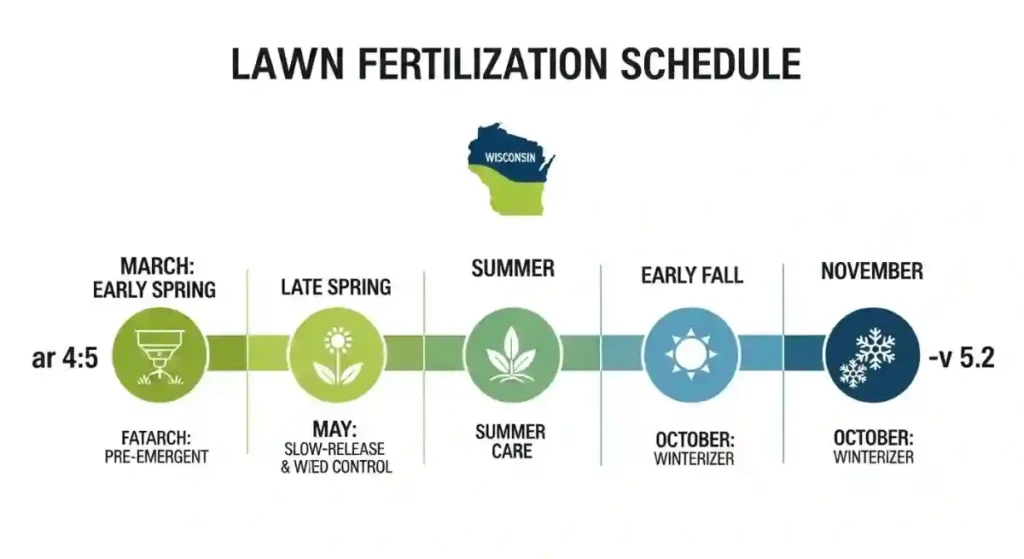
Month-by-Month Lawn Fertilization Schedule for SE Wisconsin (Summary)
Month | Primary Goal | Fertilizer Type (Example N-P-K) |
|---|---|---|
March-April | Spring Green-up, pre-emergent for weeds | High N, slow-release (20-5-10) |
May-Early June | Sustain growth, strengthen roots | Balanced N, slow-release (20-0-15) |
July-August | Maintain, stress tolerance (avoid heavy feed) | Light feed, high K, or organic |
September | Post-summer recovery, root growth | High N, slow-release (24-0-10) |
Oct-Nov | Winterizing, carbohydrate storage | N-rich winterizer (18-0-6) |
(Consider adding a downloadable infographic of this calendar for your users!)
Choosing the Right Fertilizer & Application for Your SE Wisconsin Lawn
Selecting the right fertilizer goes beyond just timing. It’s about understanding what you’re applying and how.
Understanding N-P-K Ratios
Every bag of fertilizer has three numbers: N-P-K (Nitrogen-Phosphorus-Potassium).
- N (Nitrogen): For green, leafy growth. The most crucial nutrient for grass color and density.
- P (Phosphorus): For root development and cell growth. Often restricted in SE WI unless a soil test shows deficiency.
- K (Potassium): For overall plant health, disease resistance, and stress tolerance (heat, cold, drought).
For most established lawns in SE Wisconsin, a high-nitrogen, low-phosphorus, and moderate-to-high potassium blend (e.g., 20-0-10, 24-0-6) is ideal, especially after a soil testing reveals your specific needs.
Slow-Release vs. Quick-Release
- Slow-Release: This is highly recommended for most Wisconsin lawn care applications. It provides a steady, consistent nutrient supply over several weeks, reducing surge growth, minimizing nutrient leaching, and extending the feeding period. Look for terms like “ureaform,” “sulfur-coated urea,” or “organic nitrogen” on the label.
- Quick-Release: Provides an immediate burst of nutrients, good for rapid green-up in early spring, but can lead to nutrient loss and potential burning if over-applied. Use sparingly.
Granular vs. Liquid Fertilizers
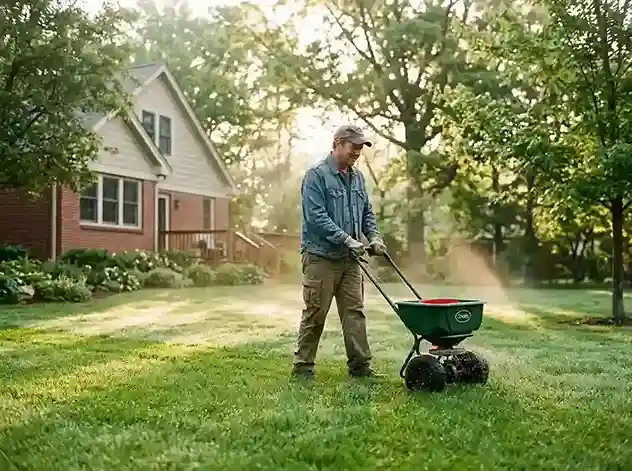
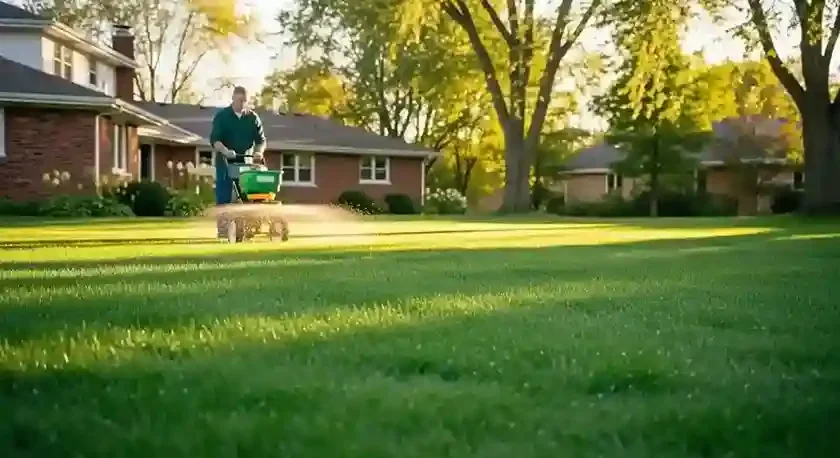
- Granular: The most common choice for homeowners. Easy to apply with a spreader, granular fertilizers are typically slow-release and provide long-lasting results. A 15-lb bag of quality granular fertilizer usually costs $40–$70 and covers about 5,000 sq. ft. for a single application.
- Liquid: Ideal for quick nutrient boosts or targeted micronutrient applications. Liquid fertilizers can be applied using a hose-end sprayer and deliver faster results but their effects tend to be shorter-lived compared to granular types.
Detailed Application Rates
This is one area where many homeowners get confused — but it’s simpler than it seems! The first rule: always read your fertilizer’s product label for exact instructions.
As a general guideline for cool-season grasses, apply 0.75 to 1 pound of actual nitrogen (N) per 1,000 square feet each time you fertilize.
Here’s how to calculate it:
If your fertilizer bag says 20-0-10, that means it contains 20% nitrogen.
To apply 1 pound of nitrogen per 1,000 square feet, divide 1 lb N ÷ 0.20 = 5 lbs of fertilizer.
So, you’d spread 5 pounds of that fertilizer evenly over every 1,000 square feet of lawn.
Tip: Knowing your lawn’s total square footage is essential for accuracy. You can measure it manually using a tape or wheel, or use free online mapping tools to get a quick estimate.
Essential Fertilization Tips & Best Practices for SE WI Success
Beyond the schedule, how you fertilize and what you do around it makes a huge difference.
1. The Power of Soil Testing
This step cannot be emphasized enough. Conducting a soil test every 2–3 years reveals your soil’s pH, organic matter content, and exact levels of macro- and micronutrients. With this data, you can customize your fertilization plan, save money, and avoid unnecessary nutrient applications that may harm your lawn or the environment.
Local Resources:
- University of Wisconsin–Extension (UWEX) Soil & Forage Analysis Lab: The gold standard for accurate soil testing. For about $15–$25 per sample, you’ll receive detailed results and science-based recommendations. Many local UWEX offices—such as those in Waukesha or Milwaukee—can also help you interpret your results.
- Local Garden Centers: Stores like Johnson’s Nursery or Stein’s Garden & Home often sell simple at-home soil test kits. However, for comprehensive and reliable analysis, UWEX remains the superior option.
2. Water Wisely
After applying granular fertilizer, always water it in lightly. This helps move the nutrients into the soil where roots can access them and prevents “burning” the grass. Aim for about ¼ to ½ inch of water. For liquid applications, follow product instructions regarding post-application watering.
3. Mow Smart, Not Just Short
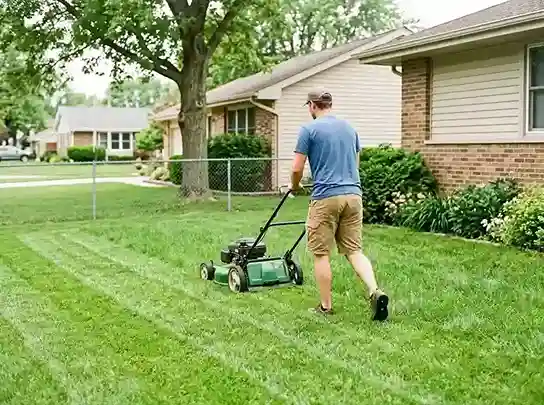
Maintaining a taller mowing height (3-4 inches) encourages deeper roots, shades out weeds, and helps the grass tolerate stress. Leave grass clippings on the lawn; they are a natural source of nitrogen and organic matter, effectively recycling nutrients. This is especially beneficial for grass health in SE WI.
4. Environmental Stewardship in SE Wisconsin
Our region’s natural beauty is defined by its water — from Lake Michigan and the Milwaukee River to Pewaukee Lake and Geneva Lake. Practicing responsible lawn fertilization is essential to protect these valuable waterways from pollution and runoff.
Here’s how you can make a difference:
- Avoid over-application: More fertilizer doesn’t mean a greener lawn — it often leads to nutrient runoff that harms local lakes and rivers.
- Sweep, don’t hose: If fertilizer spills onto sidewalks or driveways, sweep it back onto the lawn. Never hose it into storm drains; they lead directly to our waterways.
- Watch your phosphorus: Follow Wisconsin’s phosphorus regulations, which limit phosphorus use in most lawn fertilizers.
- Choose organic options: Consider eco-friendly products like Milorganite (a proud Milwaukee product!). It’s slow-release, phosphorus-free, and helps improve long-term soil health.
💡 Did You Know?
Even a small amount of fertilizer washed away during heavy rain can contribute to algae blooms and poor water quality in nearby lakes and rivers. A few extra minutes of care today helps keep Southeastern Wisconsin’s waters clean and vibrant for everyone.
5. Adapt to Weather & Conditions (Problem-Solving Scenarios)
- Drought: If SE Wisconsin experiences severe drought, reduce or postpone fertilization. Water deeply and infrequently if you do water.
- Excessive Rain: Heavy rain after application can wash away nutrients. If a significant washout occurs, consider a light follow-up application after the rain subsides and the soil dries.
- Pests/Diseases: A healthy, properly fertilized lawn is more resilient. If you spot specific issues, consult your local UWEX office or a reputable lawn care professional. Sometimes, adjusting the fertilization (e.g., adding potassium for disease resistance) can help.
6. Looking Ahead: 2026 Trends in Lawn Care
The trend for 2026 and beyond in SE Wisconsin is a move towards more sustainable, data-driven, and soil-health-focused lawn care. This includes:
- Increased reliance on soil test data for precision feeding.
- Greater adoption of organic and natural fertilizers.
- Water-wise irrigation techniques.
- Integrated pest management (IPM) to reduce chemical use.
- Focus on native plant landscaping to reduce overall lawn area and maintenance needs.
FAQs About Lawn Fertilization in SE Wisconsin
Why Homeowners Trust Preme Landscaping & Lawn Care
✅ Affordable, transparent pricing — enjoy premium-quality lawn care without overspending.
✅ Reliable and punctual service — we stick to a consistent mowing schedule so your lawn always looks neat and well-maintained.
✅ Local expertise you can count on — our team understands Wisconsin’s climate and Kenosha’s specific grass varieties.
✅ Comprehensive lawn maintenance — mowing, trimming, edging, and cleanup are all included for a hassle-free experience.
📞 Call us today at (262) 360-0202 or click below to schedule an appointment!
👉 [Get a Free Quote] or [Book Lawn care Service]
Proudly serving:
Kenosha • Pleasant Prairie • Somers • Bristol • Mount Pleasant • Racine • and surrounding communities.
Conclusion: Your Green Journey Starts Now
Mastering the lawn fertilization schedule for Southeastern Wisconsin is a journey, not a one-time task. It’s about understanding your local environment, observing your lawn’s unique needs, and adjusting your approach through the seasons.
By following this comprehensive guide, prioritizing soil testing, choosing the right fertilizer products, and practicing environmental responsibility, you’re setting yourself up for success. The result is a lawn that’s not only the envy of your neighborhood but also a reflection of healthy, sustainable living.
Ready to transform your lawn?
Start with a soil test today, then prepare for your next scheduled application. Every step brings you closer to that lush, green, Wisconsin-perfect lawn you’ve always wanted.
Related Lawn Care Guides for Kenosha Homeowners
Keep your lawn looking its best all year long with these expert-written guides, each tailored for Wisconsin’s climate and Kenosha-area lawns.
Best Height to Mow Grass for a Healthy Lawn
Learn the recommended grass height for Kenosha lawns to encourage deep roots, reduce weeds, and maintain vibrant green color. Proper mowing height is key to a durable, stress-resistant lawn year-round.
When to Aerate and Overseed in Wisconsin’s Growing Season
Discover the ideal timing to aerate and overseed your cool-season grass. Proper scheduling promotes strong roots, fills in bare spots, and keeps your lawn lush and healthy throughout summer.
How to Prepare Your Lawn for Winter in Kenosha
Follow our step-by-step tips to winterize your lawn before the cold sets in. From your final mow of the season to protecting turf from snow mold, you’ll ensure your grass bounces back strong in spring.